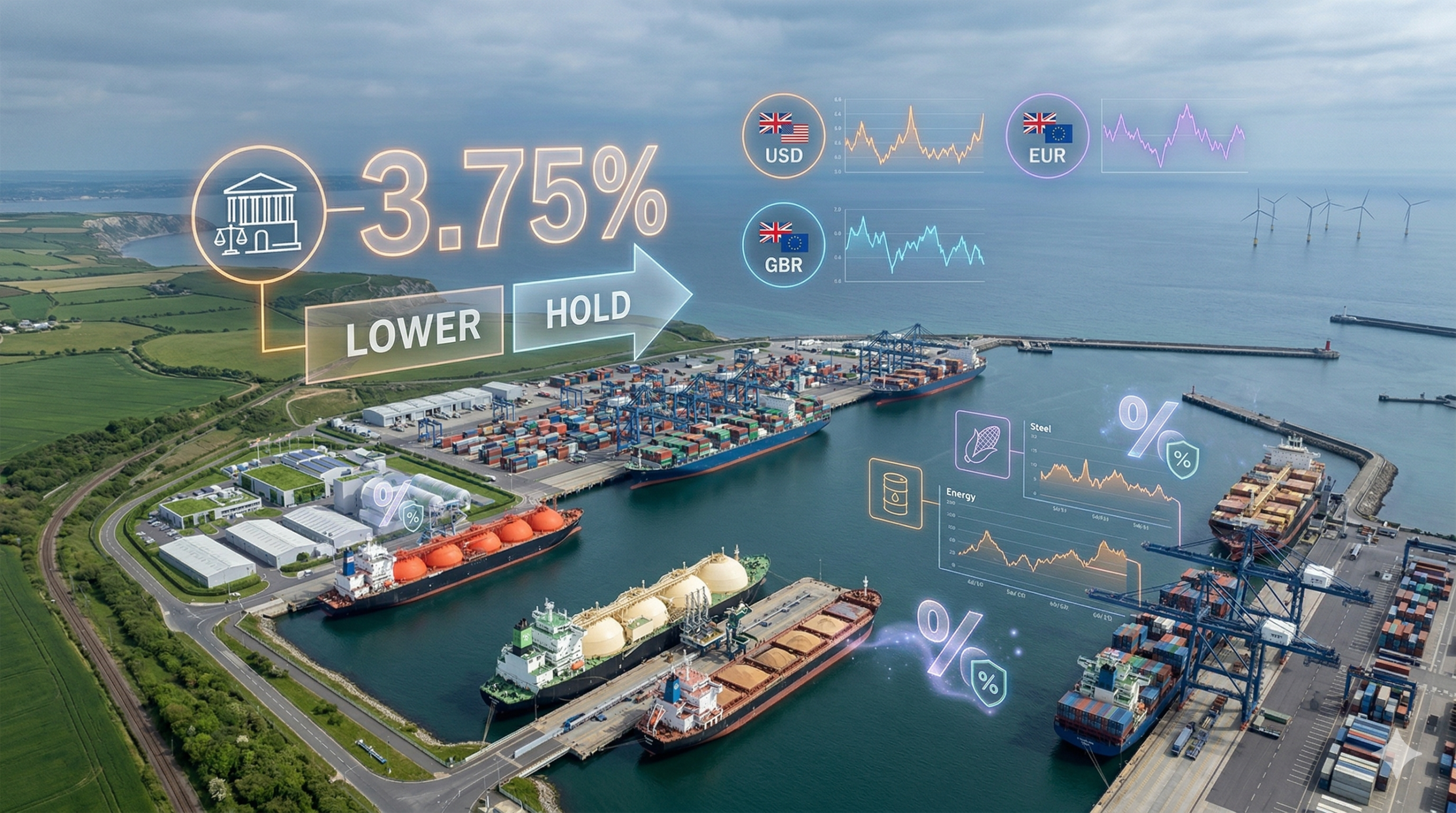
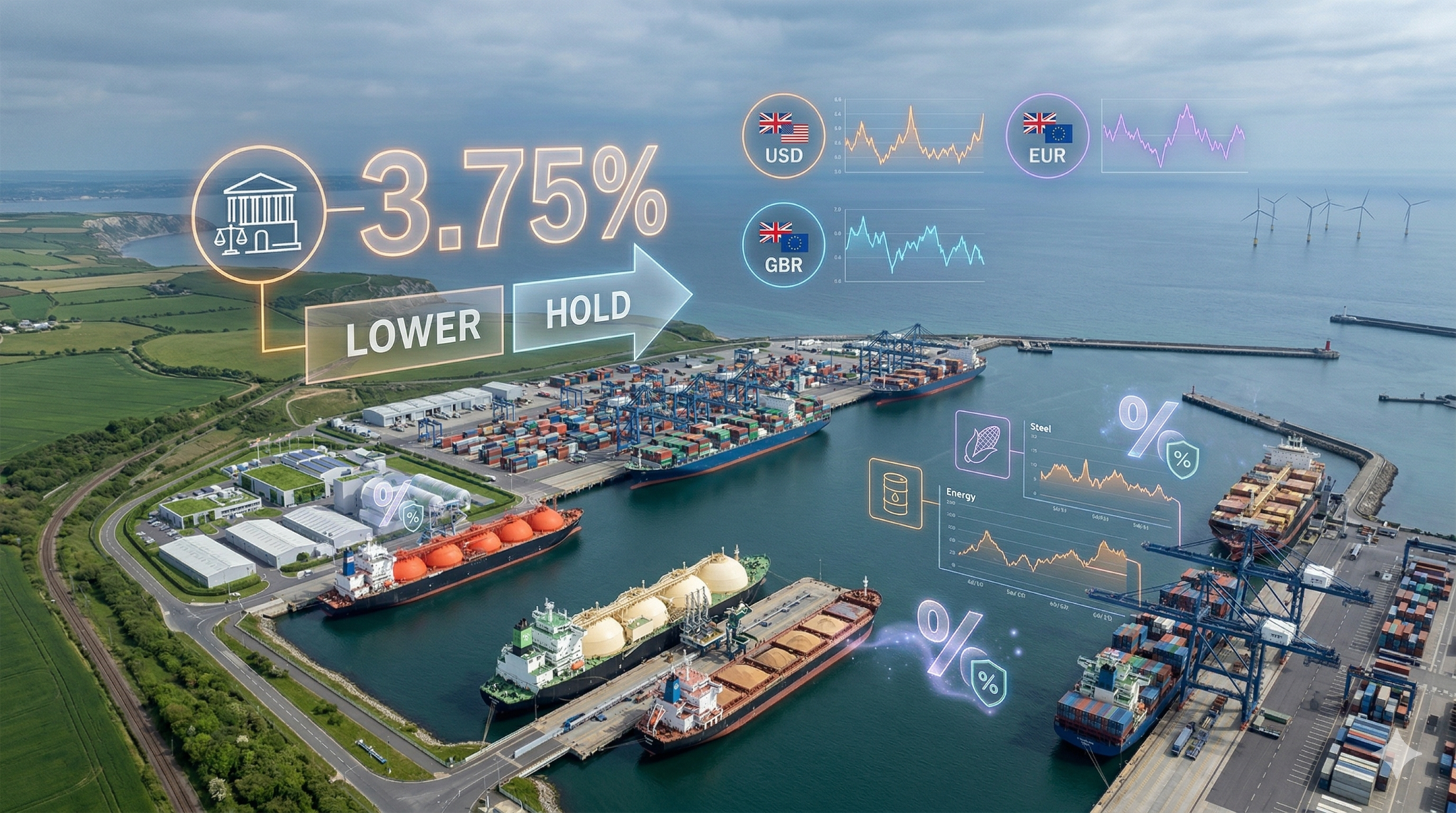
The Bank of England’s latest decision was to hold interest rates at 3.75%; however, it was a very close vote this time. The Governor’s signal that further reductions should be on the table this year, reflects just how uncertain the economic landscape has become.
Right now, interest rates aren’t moving in isolation, and UK businesses buying commodities from abroad are now facing a shifting landscape for both borrowing costs and international trade. New tariffs, currency movements, and commodity prices are all converging at once, and determining the price you pay for raw materials.
For any business reliant on fuel, metals, or agricultural inputs, these forces are not just increasing volatility in individual markets, they are reshaping your entire cost base at the same time.
How do interest rates impact currency and commodity rates?
The relationship between interest rates and commodity prices operates through currency markets.
When the Bank of England cuts rates, sterling typically weakens against the dollar. Lower UK rates make pound-denominated investments less attractive to international investors, reducing demand for the currency. As sterling falls, the cost of dollar-priced commodities rises for UK buyers, even if the underlying commodity price hasn’t changed at all.
Since most globally traded commodities are priced in US dollars, a rate cut from the Bank of England can quietly raise the cost of every tonne of metal, every barrel of fuel, and every bushel of grain you buy, without a single commodity market moving.
If you are unsure how exposed your business is, tools like the Explore Zone can help you map your commodity inputs and understand where your cost base is most vulnerable.
Why have trade dynamics become considerably more complex in 2026?
Trade dynamics have become more complex because global events are feeding directly into both supply chains and currency movements. The challenge for businesses is not tracking every event, but understanding how these shifts translate into input costs.
The 10% US tariff on British goods falls most heavily on metals, electronics, and vehicles – key inputs for construction firms, food processors, and manufacturers.
Copyright © 2025 Rebecca Abigail PR Ltd. All rights reserved. All ideas remain the Intellectual Property of Rebecca Abigail PR Ltd.
When global supply chains are disrupted by tariff friction, commodity prices feel the strain even in markets that aren’t the direct target. Most SMEs are also challenged by commodity exposure across multiple raw materials simultaneously, so trying to forward-plan is difficult when the trade environment remains deeply unpredictable.
Construction contractors are a clear example of this. US tariffs on aluminium and steel are set to expire in July, leaving uncertainty for future material costs. Meanwhile, the US-Iran conflict has skyrocketed fuel prices, and tightening copper supply has supported an elevation in London Metal Exchange prices, squeezing project profit margins and bringing the financial viability of tenders priced months in advance under question.
On top of this, a single currency move can hit fuel, metals, and agricultural inputs all at once. Since most businesses are exposed across multiple commodities, this impact compounds.
When the dollar strengthens, the sterling cost of your entire raw material base rises simultaneously, and what looks like a healthy margin on paper can change before a single order is fulfilled.
This is the currency risk that SMEs most commonly underestimate, and in the current environment, most can’t afford to.
What do exchange rate movements mean for SMEs right now?
Sterling has held up better than many predicted heading into 2026, supported partly by the Bank of England’s caution on rate cuts and by relative fiscal stability following the Autumn Budget. But that resilience is fragile due to the prospect of rate cuts in April or June, ongoing questions about UK growth, and geopolitical volatility driving sudden shifts in dollar demand.
For UK manufacturers, food processors, construction firms, or any business reliant on raw materials, even a 3-5% move in GBP/USD can be the difference between a profit and loss. The cumulative impact across commodities on a business’s cost base can be severe.
Larger businesses will have dedicated treasury teams and can access sophisticated hedging instruments to manage this. However, for smaller firms, currency-commodity risk has traditionally come with three structural barriers:
- Complexity: Traditional hedging requires understanding both currency markets and commodity derivatives, often requiring specialist advice
- Cost: Banks typically reserve preferential pricing and hedging services for larger clients with substantial volumes
- Time: Managing multiple hedging relationships and monitoring positions diverts attention from business owners doing what they know best
How can I take control of my input costs?
The first step is knowing where your business exposure actually sits: which of your inputs are dollar-linked, how much of your cost base do they represent, and how sensitive are your margins to currency movements?
Copyright © 2025 Rebecca Abigail PR Ltd. All rights reserved. All ideas remain the Intellectual Property of Rebecca Abigail PR Ltd.
That’s exactly what our Explore Zone is built for.
Rather than diving straight into hedging, it starts with your business, helping you model your commodity risk across fuel, metals, and agricultural inputs. It shows you, in practical terms, how a 5% or 10% move in GBP/USD can impact your margins, turning macro risk into measurable figures.
Looking Ahead
Business input costs are not driven by commodity markets alone. They are shaped by the interaction between interest rates, currency movements, and global trade conditions.
Most businesses underestimate how connected these forces are, and as a result, underestimate their true exposure.
The good news is that currency-commodity risk, while real and right now heightened, is manageable.
Visit our Explore Zone to model your risk exposure and see what hedging could mean for your business.